Building one character at a time, with 75% lower costs: SupportManager’s story
Tom Easterbrook was born with cerebral palsy. He is a full-time wheelchair user, and he types his code one character at a time. Every keystroke costs him time and physical energy, so the tools he chooses have to earn their place.
With a lot of stacks, a developer working under those constraints could really struggle to ship a real product. The amount of boilerplate code alone would probably eat your runway. But Laravel changed the math for Tom. Its opinions and conventions covered the wiring, so his limited keystrokes could go straight to the actual problems he set out to solve.
That solution is SupportManager, a UK platform built to make it easier for people who receive direct payments. These are cash payments from their local authority given in place of council-arranged social care so the person can hire and manage their own support.
This is a challenge Tom set out to solve for himself: he receives direct payments, employs a small team of 10 personal assistants (PAs), and runs the payroll every month. He is both the person receiving care and the employer responsible for the wages. SupportManager is what he built to make that manageable, first for himself, and next for everyone else in the same position. He plans to onboard the first batch of trial users later this year.
Tom moved SupportManager from Laravel Forge to Laravel Cloud. His move to Cloud brought a number of benefits:
a 75% cut in costs for a more enterprise-ready infrastructure, with scale to zero, managed queues, and similar background services that only cost money when they are actually working;
zero server management on Tom's plate, so ongoing infrastructure work no longer competes with his limited keystrokes and physical energy;
10 to 15 hours a month saved for Tom personally, running payroll and HR for a team of 10 personal assistants.
The challenge: The employer duties nobody prepares direct payment recipients for
While direct payments give disabled people in the UK real independence, they come with a catch. If you hire your own PAs, you legally become their employer, with payroll, tax submissions to HMRC (the UK's tax authority, equivalent to the IRS in the US), employment contracts, schedules, and holiday pay all landing on you. Over 120,000 people in England hold these arrangements, most with no HR or payroll background whatsoever.
"The vast majority either do it all on paper-based forms or with some kind of hacked-together Excel spreadsheet. And because payroll feels like a big, scary concept, many people, or the people who fund them, pay large amounts of money to payroll providers,” said Tom.
Generic HR or enterprise resource planning tools do not solve this. "What we need is a system that does input and output really well in an accessible way, but also one that quietly works away in the background, anticipating what's coming rather than waiting to be asked, with a healthy dose of AI, to remove that burden and help people proactively live what are already complex, independent lives."
How Laravel’s opinionated framework saved thousands of keystrokes
Tom studied computing at Bournemouth University, where a web programming assignment introduced the class to MVC (model, view, controller) frameworks through CakePHP. He had already dabbled in Laravel on the side and eventually used the framework for his final-year dissertation and, later, as the foundation for SupportManager.
The framework's opinions meant I could spend my limited keystrokes on solving the actual problem instead of wiring things together.
The stack today is Laravel 13, Livewire, Tailwind, and Flux UI, with MySQL underneath. SupportManager began on Filament, which let Tom drive the interface entirely from PHP during years when AI could not yet produce solid UI on demand. As the product moved into harder territory like payroll, the team reached outside Filament more and more, and Flux became the natural next step.
The solution: A Laravel ecosystem to build, run, and manage the app
Tom groups the ecosystem into three parts: the tools he builds with, the tools that run it, and what lives inside the app itself.
Building: Herd plus Boost plus voice-driven Claude Code
Laravel Herd gives Tom queues, database, and sessions in one bundle, with no tinkering. Every minute of tinkering he saved is a minute he put into the actual product.
The bigger shift came from AI. His first MVP of SupportManager, which covered vacation days and simple user management, took nearly a year to build, even with Filament. Today, he drives Claude Code with his voice, and Laravel Boost supplies the tools and skills to make those sessions productive.
Running: Laravel Forge to Cloud, plus Nightwatch
Tom's infrastructure story has more turns than most. He started on Laravel Forge, running SupportManager on self-managed servers at around £60 (roughly $79.5) a month. When Laravel Cloud launched, he moved across, drawn to the idea of shipping ops work off his plate entirely. The first Cloud stint cost more than Forge, so he moved back to Forge for a while for cost and consistency.
What brought him back was scale-to-zero compute and Cloud's managed queues. SupportManager is a workload with quiet stretches, and paying for compute during those stretches was why Cloud was expensive the first time. With scale-to-zero, his bill dropped to around £15 (about $20) a month, and the queue workers, cache, and scheduler he used to pay for as always-on servers on Forge now sit inside Cloud as managed services with no idle bill attached.
The result is a smaller monthly bill and a more enterprise-ready posture at the same time. Nothing runs when nothing needs to, and no separate boxes run for pieces that used to demand their own uptime.
Laravel Nightwatch, integrated into Cloud, closes the loop by surfacing problems fast, like slow requests and database queries. Tom feeds those alerts into AI so users get a timely response even when his own physical energy is exceptionally limited.
Manage the app: Laravel AI SDK
The Laravel AI SDK lets SupportManager lean on LLMs safely and securely, but AI is only one half of how the app anticipates things. Good old-fashioned algorithms handle the other half, quietly running the recurring patterns and payroll conditions Tom has coded in, so the app can flag what is coming before someone has to ask.
The AI SDK picks up where those rules run out of road. Together, they are the difference between a tool people have to remember to use and a tool that quietly lightens the load of their day.
What changed for Tom, and what changes for his users
Today, SupportManager saves Tom 10 to 15 hours a month by offloading payroll and management for a team of 10. He is preparing to onboard the first hand-picked trial users by the end of the year, then move into conversations with the UK organizations that fund direct payments arrangements in spring next year.
Accessibility shaped every choice Tom made in the platform, from the input and output design to the AI features that work quietly in the background.
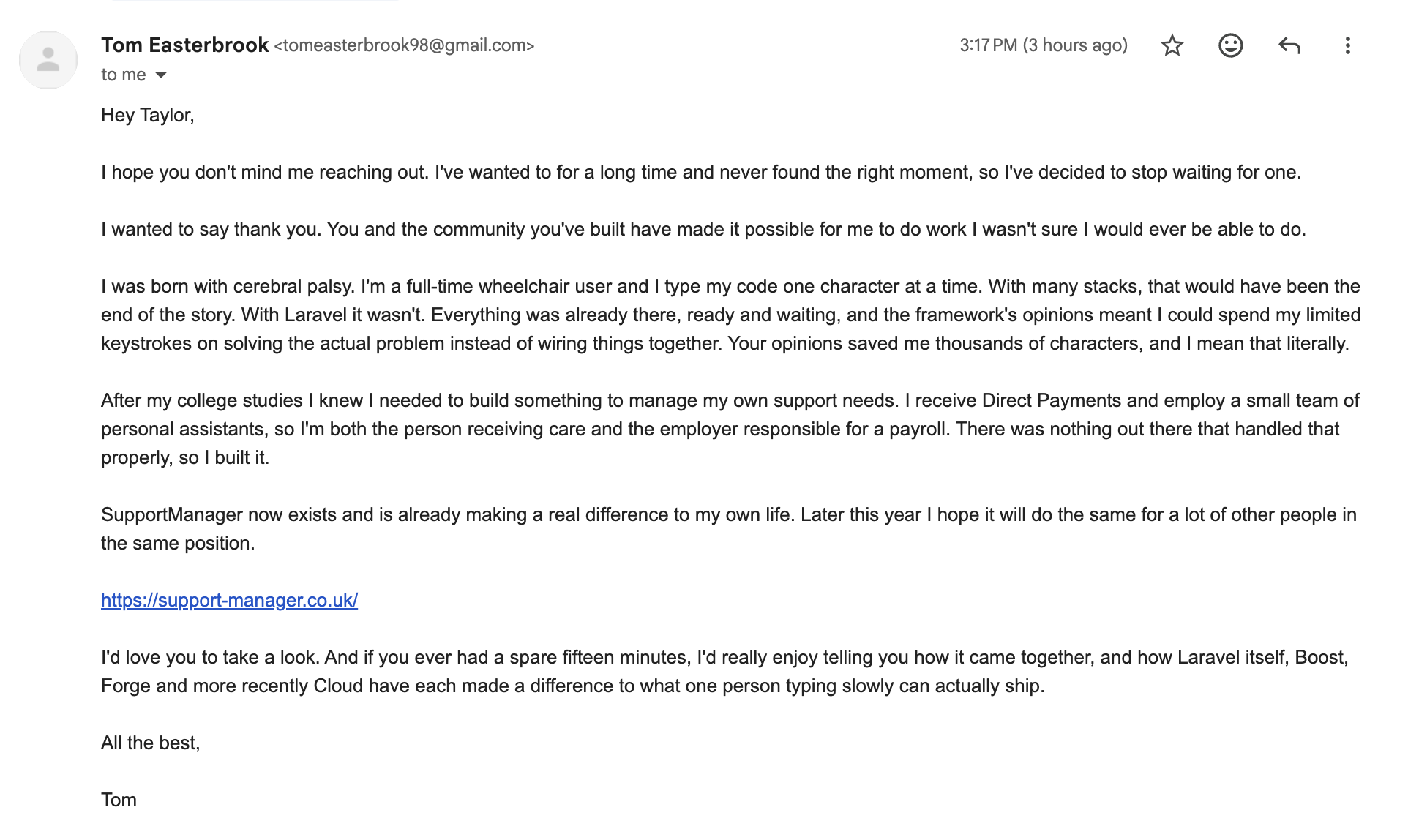
Tom shared his story in an email he sent to Taylor, Laravel’s CEO
"Now is the best time there has ever been to be a developer with a disability. We're no longer in a space where your ideas are limited by your physical limitations, and you can truly go wherever your talents may take you," he said.
SupportManager is actively looking to raise from early-stage UK investors who believe in the power of lived experience to solve real-world problems. If that is you, Tom would like to hear from you through support-manager.co.uk.
Build, deploy, and scale on Laravel Cloud
SupportManager is one developer, typing one character at a time, running a real payroll and HR platform on Laravel Cloud, at a quarter of the infrastructure cost of the setup it replaced.
If you are building a real application and want the framework and platform to carry the bulk of the work, give Laravel Cloud a try to see how simple cloud infrastructure can actually be.
SupportManager

Problem
As SupportManager approached its first trial users, running it on self-managed servers demanded ongoing operational attention that founder Tom Easterbrook, working with limited keystrokes and physical energy, could not afford to give.
Solution
Laravel Cloud with scale-to-zero compute removed server management entirely and cut SupportManager's infrastructure bills by 75%, while Laravel Nightwatch surfaces slow requests and queries fast enough for Tom to respond even on low-energy days.
Subscribe to the Laravel Blog
Stay connected with Laravel and receive news in your inbox.
Don't miss these