Laravel Cloud vs. Heroku
Laravel Cloud gives you the infrastructure thousands of production applications trust—built and maintained by the Laravel team.
Laravel Cloud
Laravel Cloud is built and maintained by the Laravel team. Deployments in under a minute. Scale to zero. Managed databases, caches, and object storage included.
- Ship without fighting infrastructure. Built by the Laravel team, Cloud natively supports Laravel's AI tools, Octane, the Laravel scheduler and queues, and zero-downtime deployments.
- Sleep soundly with autoscaling. Compute, queue workers, and schedulers scale independently based on real demand.
- Autoscale with traffic and automatically scale to zero when idle.
Heroku
Heroku is a general-purpose PaaS owned by Salesforce that supports Laravel via generic PHP buildpacks. It entered maintenance mode in February 2026, meaning no new features, no new enterprise contracts, and a platform that's falling further behind the Laravel ecosystem every month.
- Generic PHP buildpack support requires manual Procfile configuration, buildpack setup, and separate worker dynos for queues and scheduled tasks.
- Billing fragments across dynos and every add-on, with no built-in cost forecasting tools.
- No new features in development; enterprise contracts no longer available to new customers.
Teams like these don't manage infrastructure.




“We're spending ~$200/month on Laravel Cloud compute compared to ~$1,000/month on Heroku dynos and seeing comparable performance.”

Dwight Watson
COO at Roomies
Why Laravel Cloud is better than Heroku
Deploy in under 60 seconds with no Procfiles or buildpacks.
Built for Laravel and actively developed, unlike Heroku.
Save up to 50% on infrastructure costs compared to Heroku.
Migrate from Heroku to Laravel Cloud
Heroku is in maintenance mode. Laravel Cloud is where your apps go next.

Laravel Cloud compared to Heroku
Laravel Cloud outperforms Heroku with native Laravel support, minimal-configuration deployments, and up to 50% savings on infrastructure costs.
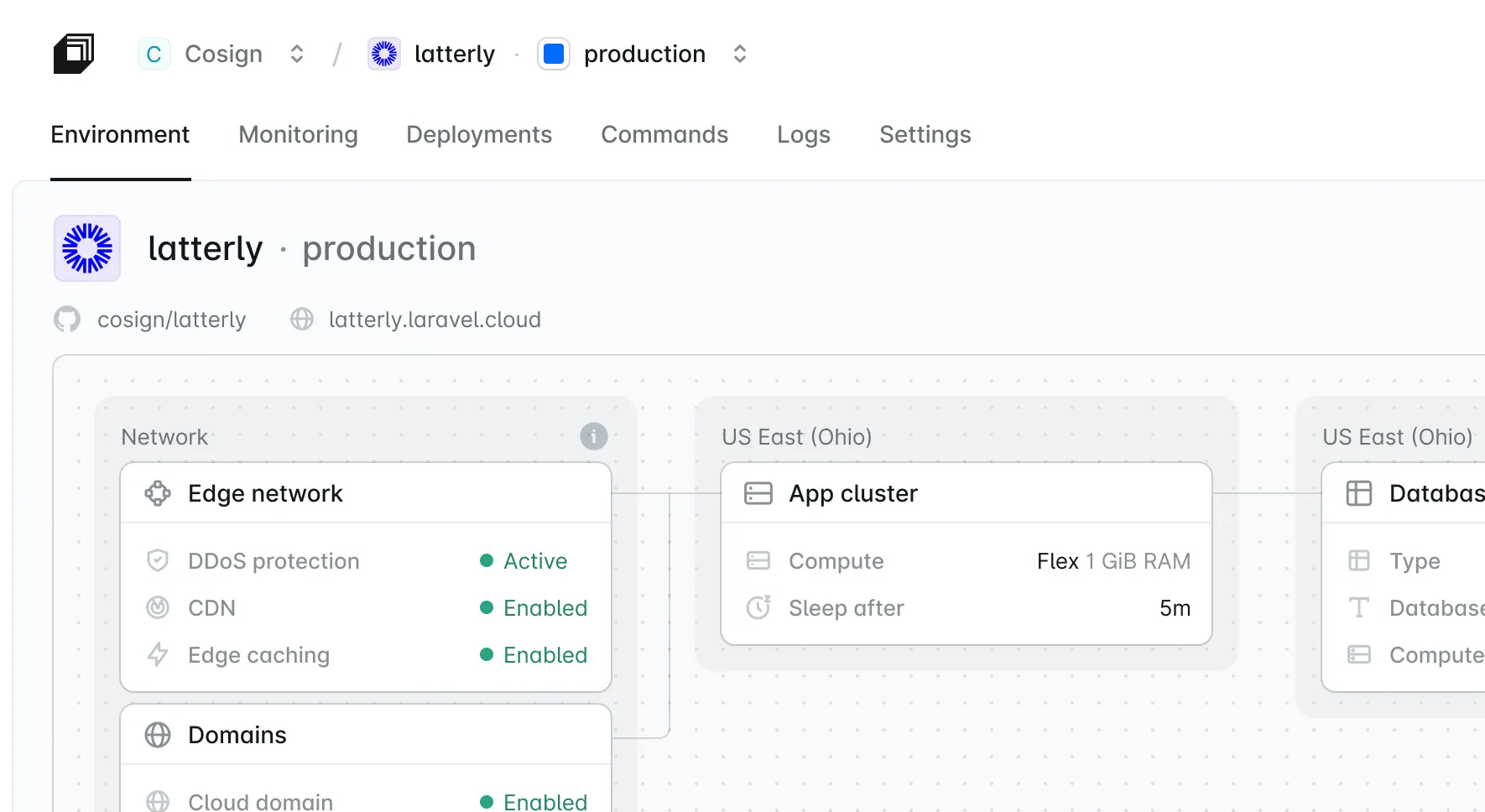
Laravel Cloud is a fully managed platform built by the Laravel team, supporting Laravel and Symfony apps with one-click autoscaling, native queue workers, databases, cache, and security. Actively developed alongside the framework and PHP ecosystem.
Heroku is a general-purpose PaaS in Salesforce maintenance mode since February 2026. Supports PHP via buildpacks but has no native understanding of Laravel's architecture. Horizon, Octane, and the scheduler are things you configure yourself.
Laravel Cloud is a fully managed platform built by the Laravel team, supporting Laravel and Symfony apps with one-click autoscaling, native queue workers, databases, cache, and security. Actively developed alongside the framework and PHP ecosystem.

Built and maintained by the Laravel team

Generic PHP buildpack, no Laravel-native features
Built and maintained by the Laravel team
Actively developed by the Laravel team
Maintenance mode since February 2026
Actively developed by the Laravel team
Laravel, Symfony
Ruby, Node, Python, PHP, Go, Java, and more
Laravel, Symfony
Control your infrastructure from code or the CLI
Greater control over dyno configuration and add-on selection
Control your infrastructure from code or the CLI
Laravel Cloud delivers automatic scaling that adjusts instantly to traffic, with compute, queue workers, and schedulers each scaling independently based on actual demand. Deploys in under a minute with zero downtime.
Scaling on Heroku means adding or resizing dynos across the board as there's no separation between web, worker, and scheduler workloads. You end up overprovisioning to handle spikes, and paying for it whether traffic arrives or not.
Laravel Cloud delivers automatic scaling that adjusts instantly to traffic, with compute, queue workers, and schedulers each scaling independently based on actual demand. Deploys in under a minute with zero downtime.
Under 60 seconds from Git
Git push works, but requires Procfile and buildpack setup first
Under 60 seconds from Git
Autoscaling with zero downtime
Manual dyno scaling; no separation of web, worker, and scheduler
Autoscaling with zero downtime
Zero configuration required
Procfiles, buildpacks, config vars, and add-on management
Zero configuration required
Horizon, queues, and scheduler are first-class features
Requires manual Procfile config and separate worker dynos
Horizon, queues, and scheduler are first-class features
Laravel Cloud takes you from Git to live in one step, with automatic builds and zero-downtime deployment. When deployment is this fast and reliable, your engineering team spends less time on infrastructure and more time shipping, moving on to the next project sooner. Read more about Laravel Cloud's architecture.
Heroku's git-based deployment is genuinely good, but getting a Laravel app production-ready means writing a Procfile, configuring a PHP buildpack, and manually wiring up queue workers and cron jobs. Every time a Laravel developer deploys to Heroku, they spend time on infrastructure that should be spent building product.
Laravel Cloud takes you from Git to live in one step, with automatic builds and zero-downtime deployment. When deployment is this fast and reliable, your engineering team spends less time on infrastructure and more time shipping, moving on to the next project sooner. Read more about Laravel Cloud's architecture.
Seamless, minimal-config deployment (GitHub, GitLab, and Bitbucket support) with preview environments
Strong. Git push and GitHub integration are genuinely excellent
Seamless, minimal-config deployment (GitHub, GitLab, and Bitbucket support) with preview environments
Built into the platform via rolling updates and replicas
Supported out of the box, but depends on your configuration
Built into the platform via rolling updates and replicas
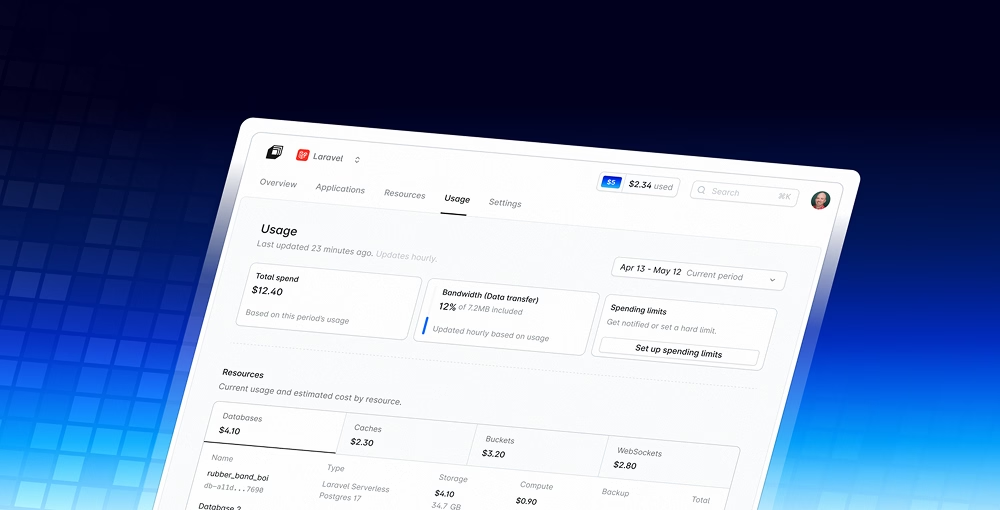
Laravel Cloud's Starter plan is $5/month and comes with $5 in recurring usage credits. Applications, databases, and cache can all scale to zero when idle, so you don't pay for compute that isn't serving requests.
Users switching from Heroku are saving up to 50% on infrastructure costs.
Heroku's billing is fragmented across dynos, Postgres, Redis, and every add-on in your stack. Costs compound as you scale, and there's no built-in calculator or forecasting tool to see it coming.
Laravel Cloud's Starter plan is $5/month and comes with $5 in recurring usage credits. Applications, databases, and cache can all scale to zero when idle, so you don't pay for compute that isn't serving requests.
Users switching from Heroku are saving up to 50% on infrastructure costs.
Pay only for active compute, with scale-to-zero, spending limits, and billing alerts
Separate billing for dynos and every add-on
Pay only for active compute, with scale-to-zero, spending limits, and billing alerts
Start for free with $5 in usage credit
No free trial available
Start for free with $5 in usage credit
Laravel Cloud offers metrics like real-time logs, metrics, and error tracking. Optional Nightwatch integration for Laravel-specific insights is available with minimal configuration.
Heroku has basic dashboard metrics available out of the box, but deep monitoring requires a New Relic add-on, meaning a separate account, separate billing, and setup you manage yourself.
Laravel Cloud offers metrics like real-time logs, metrics, and error tracking. Optional Nightwatch integration for Laravel-specific insights is available with minimal configuration.
Real-time infrastructure monitoring, HTTP analytics, logs, and app metrics
Basic dashboard metrics; deep monitoring requires New Relic add-on
Real-time infrastructure monitoring, HTTP analytics, logs, and app metrics
Included
SSL included; CDN requires additional configuration
Included
Daily automated database backups with point-in-time recovery. On-demand backups available.
Automated backups and point-in-time recovery available on higher Postgres tiers
Daily automated database backups with point-in-time recovery. On-demand backups available.
Who should choose Laravel Cloud vs. Heroku?

Pick Laravel Cloud
Choose Laravel Cloud if you're building on Laravel or Symfony and want a fully managed platform that scales to zero, includes everything you need, and is actively developed.

Pick Heroku
Choose Heroku if you're running a polyglot stack and are already deeply invested in its add-on ecosystem. However, given its maintenance mode status, it's worth planning your next move regardless.
Deploy now with Cloud
Start in Cloud with $5 in free usage credit.
- Launch in under a minute from Git to live with fully managed infrastructure.
- Build and ship faster with native Laravel integration across your stack.
- Scale and save costs automatically with built-in scale-to-zero.
See what thousands of developers have to say
“I have never seen a website accomplishing something so complicated, so fast, so simple, so beautifully.”

“Cloud is amazing value if you just need a small server and a PostgreSQL DB. I only use $2 a month running my badge project. We've never had it this good.”

“For my small project I needed all: DB, cache, storage, and WebSockets — and everything worked on the first try with single clicks.”

“Setting up resources on Laravel Cloud is like playing Lego blocks, you can just connect things. We used to install Nginx and MySQL manually on a server and get permission denied.”

“Cloud is absolutely goated. Smoothest infra DX I've ever experienced — everything I needed was right where it was supposed to be.”

“I was stuck on a pretty complex problem, and the Laravel Cloud support team went out of their way to deep dive into it with me. The bug was my own doing, but their tips helped me find it.”

“Charging me $5 for my 0 user PHP apps? Yes, please, thank you very much. ‘Unlimited applications’ is a goated move from Laravel.”

“Loving the new managed queues on Laravel Cloud. Offloading the workload from the app server and allowing it to sleep is genius.”

“The preview environments in Laravel Cloud have been amazing to work with. They work flawlessly, and with the fast hibernation, we barely pay for it even though we have over 15 preview environments.”

“Just deployed an app using Laravel Cloud and OMG, the deployment experience was incredibly fast and painless.”

“Laravel Cloud is the closest thing to magic I've experienced in a hosting provider. It's really the Laravel of Cloud.”

“Just shipped a huge update to my Laravel learning platform, running smoothly on Laravel Cloud. Deploys, SSL, env vars — everything just works. No DevOps headaches.”

“Any AI agent + Laravel. You can deploy this on Laravel Cloud in a few clicks.”

“Showed my friend Laravel and Laravel Cloud, and he was already deploying his first app in less than a month. He was shocked by how easy it is and how tight the ecosystem is.”

“Laravel Boost + Laravel Cloud CLI + Stripe CLI. You can pretty much build a full product without seeing a line of code.”

“I've switched all personal projects from DigitalOcean and love Laravel Cloud!”

“Laravel Cloud just keeps getting better. Having web analytics directly in the dashboard is a really nice addition. Requests, visits, views, top pages, status codes — all in one place. No extra analytics setup needed.”
Frequently asked questions
Laravel Cloud is a fully managed platform built by the Laravel team for PHP applications, including Laravel and Symfony. It automates deployment, scaling, queues, caching, and monitoring with minimal manual setup. Heroku is a general-purpose PaaS owned by Salesforce that supports PHP via buildpacks but has no native understanding of Laravel's architecture, and entered maintenance mode in February 2026.
Yes. Laravel Cloud deploys in under 60 seconds with zero configuration. Heroku's git push workflow is fast once configured, but getting a Laravel app properly set up takes significantly longer before you're production-ready.
Heroku's pricing fragments across dynos, databases, Redis, and add-ons, with no built-in way to forecast costs before the bill arrives. Laravel Cloud uses usage-based pricing with scale-to-zero and spending limits, so you never spend over budget. Users switching from Heroku are saving up to 50% on infrastructure costs.
Yes. Queue workers, Horizon, and the Laravel scheduler are first-class features on Laravel Cloud. Read how it works in the docs. On Heroku, each requires a separate worker dyno and manual setup.
Heroku entered maintenance mode in February 2026. No new features are being built, and enterprise contracts are no longer available to new customers. For teams actively building on Laravel, that's meaningful platform risk.
Yes. Laravel Cloud supports zero-downtime deployments, and your codebase moves cleanly from Git. The main migration steps involve replacing Heroku Postgres and Redis add-ons with Laravel Cloud managed equivalents. Check our Heroku to Laravel Cloud migration guide.
Yes. Laravel Cloud includes managed databases (Laravel MySQL, Serverless Postgres, and Amazon RDS for Private Cloud customers), cache, and auto-configured queue workers. On Heroku, each of these is an add-on that you provision and manage yourself.
Laravel Cloud is made for teams that want to ship Laravel or Symfony applications without owning infrastructure. Heroku is better suited to polyglot teams already invested in its add-on ecosystem, though the maintenance mode announcement makes that a harder case to make in 2026.