TL;DR: Preview environments on Laravel Cloud now get fresh resources for every pull request, so reviews never touch production. Laravel also makes it easier to build AI and search features, with per-tenant AI keys and semantic search on more engines.
The Laravel Framework added runtime AI provider configuration for tenant-specific keys, semantic and hybrid search for Typesense and Meilisearch, and Mercure support in Laravel Echo for real-time events.
Laravel Cloud upgraded preview environments so each pull request gets fresh resources and cleans up after itself when it merges or closes. It also added request metrics with no packages to install, managed database users with scoped access, and MySQL storage that grows on its own before you run out of disk.
Laravel Forge added bulk CSV import and export for redirect rules and server muting for noisy staging servers.
Laravel Framework
Build AI providers at runtime:
Ai::build()creates a provider from a config array without touching your app's configured providers. Use it for credentials you load at runtime, like each tenant's own API key. Built providers also work in failover lists.Semantic and hybrid search for Typesense and Meilisearch: Scout's Typesense engine now supports
semantic()andhybrid()searches. You can generate vectors with Laravel AI, use Typesense's auto-embedding, or bring your own. The Meilisearch engine can now use Meilisearch's own embedders too.Mercure broadcasting in Laravel Echo: Laravel's real-time event client now includes a Mercure connector. It uses the browser's native
EventSourceAPI, so there is no extra client library. It supports private, presence, and encrypted channels, plus whispers.Copy or move files between disks: New
copyToDisk()andmoveToDisk()methods stream a file from one storage disk to another, such as from local to S3.moveToDisk()deletes the source only after the copy succeeds.
Read the full Laravel Framework changelog.
Laravel Cloud
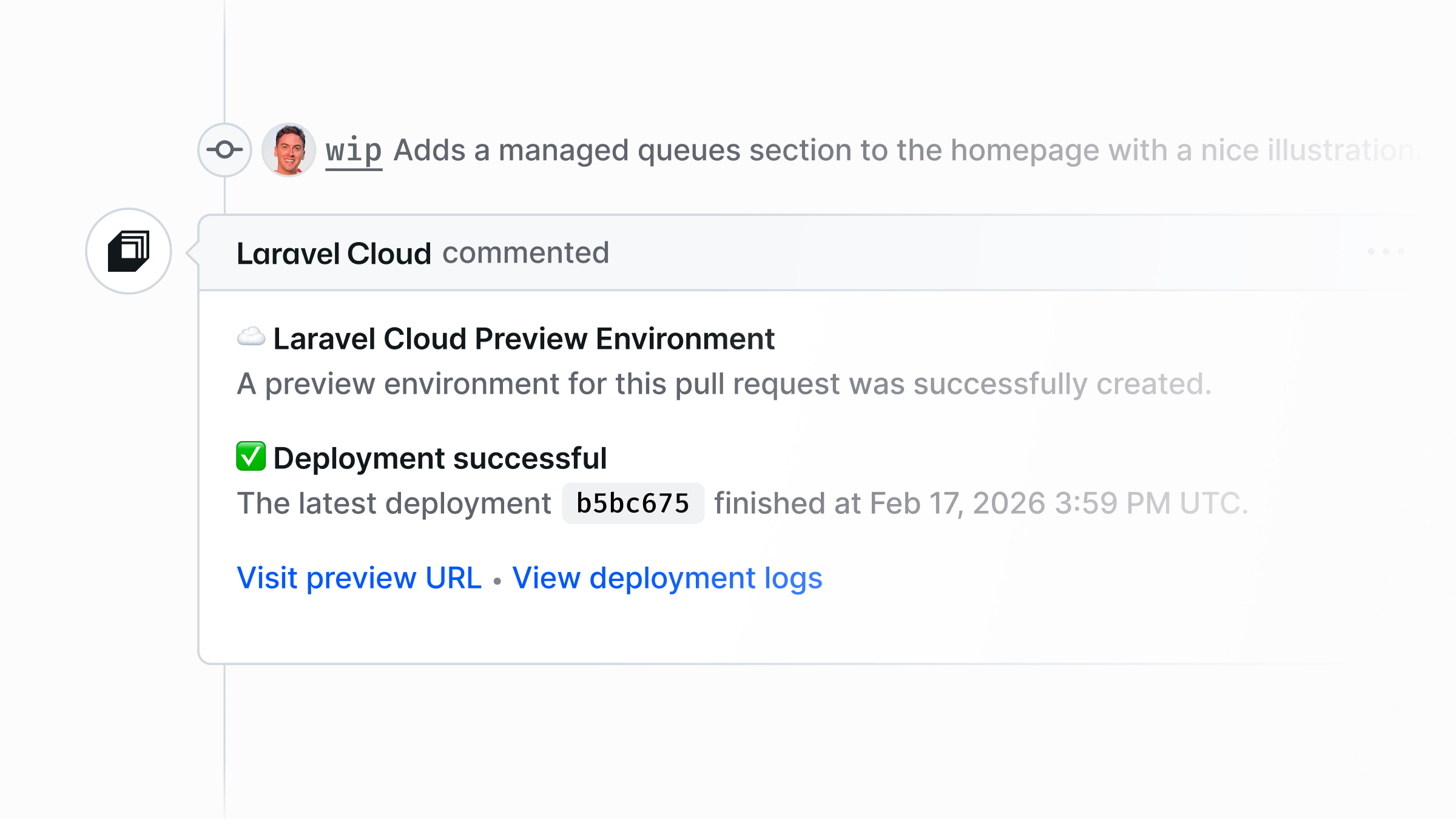
Isolated preview environments: Each preview now gets fresh resources instead of pointing at production. It sleeps between reviews on Flex sizes and is deleted when the pull request merges or closes. The Deployments page also shows a row for every open pull request with a preview, including its branch, latest commit, and a link to open it.
Request metrics: The new Requests tab under Monitoring shows request counts, response codes, and timings by page. Filter by domain and time range to find your busiest pages, errors, and slow responses. There are no packages to install and no code to change.
Managed database users: Create extra users for your database clusters instead of sharing the default credentials. Give each user read-only or read-write access, limited to the databases they need. Cloud generates a secure password for each one. This works with Laravel MySQL, RDS MySQL, and RDS Postgres.
MySQL storage auto-upsize: Laravel MySQL databases now grow their own storage before they run out of disk, and stay online while they do. When a database reaches 90% of its storage, Cloud adds 50% more. You can set a maximum size and turn it off per database at any time.
Log drains: Enterprise plans can now stream application logs in real time to an Amazon S3 bucket they own. Use it for long-term retention, compliance, or your existing observability stack.
Read the full Laravel Cloud changelog.
Laravel Forge
Redirect rule management: Import redirect rules in bulk from a CSV file, either adding to your existing rules or replacing them. You can also export a site's redirects to CSV and drag rules into the order they should run.
Server muting: Mute notifications for selected servers from your notification preferences, so staging and test servers stay out of your inbox.
Read the full Forge changelog.